The Originalists’ Climate Test
Justices Thomas, Gorsuch and Barrett refused to invent an implied constitutional immunity last term. In Suncor v. Boulder County, the oil companies are asking them to do it anyway.
On Veterans Day 2016, Army Specialist Winston Hencely was at Bagram Airfield in Afghanistan when a man approached a crowd gathered for a 5K run. The man was a Taliban operative who had gotten onto the base as a worker for Fluor Corporation, a military contractor. When Mr. Hencely moved to stop him, the man detonated a suicide vest. Five people were killed. Mr. Hencely survived with a fractured skull and permanent brain injuries.
He sued Fluor under South Carolina tort law. Fluor argued the Constitution implicitly wiped-out state law on the battlefield (and with it Mr. Hencely’s remedy) by explicitly giving the federal government the power to wage war. In April the Supreme Court said no, 6-3. Writing for the majority, Justice Thomas put it plainly: “There is no federal pre-emption in vacuo, without a constitutional text or a federal statute to assert it.” Justices Gorsuch and Barrett joined him, as did the Court’s three liberals.
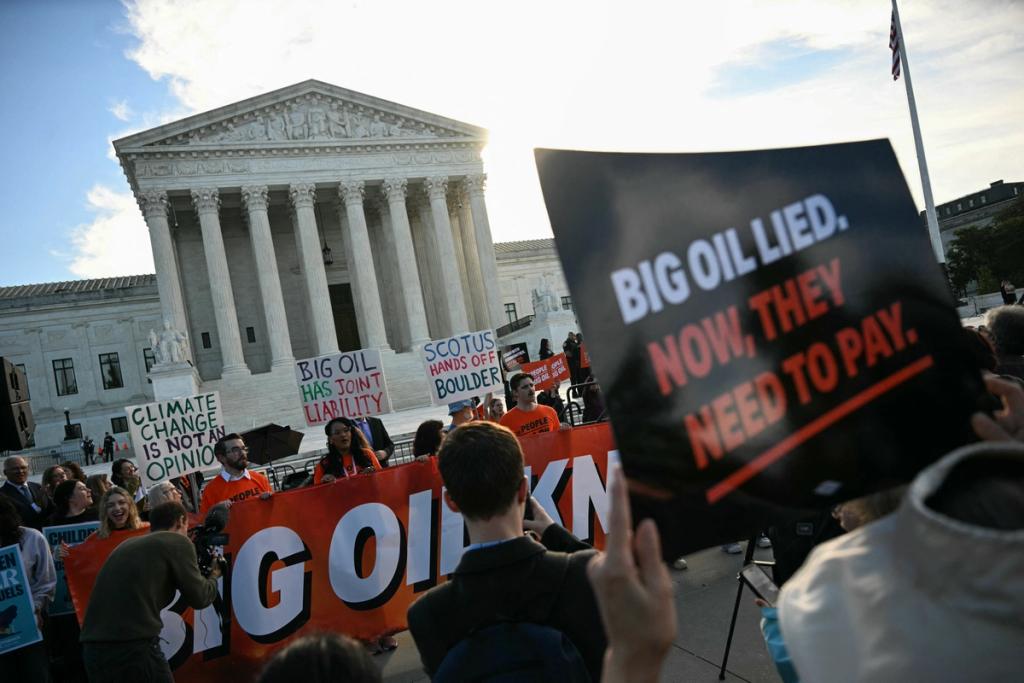
On Oct. 5 the same question returns, with facts many conservatives will find less sympathetic. In Suncor v. Boulder County, oil companies argue that the Constitution silently bars Colorado from applying its own law to harm suffered by people and property in Colorado, because the emissions that caused that harm happened outside Colorado.
It is no feat to follow your principles when they produce outcomes you like. The test comes when they lead somewhere you’d rather not go. For the conservative legal movement, Suncor is that test.
I’ll take as given that many conservatives don’t think oil companies should be on the hook for climate change. If you sat on a jury, you’d be well within your rights to hear the evidence and find that they shouldn’t be liable. If you were elected to a state legislature or to Congress, you could vote for a law giving them immunity. I’d have one or two things to say about that (as would, I suspect, some homeowners who can no longer insure their houses), but that’s democracy.
This is how the Founders set up our Republic: juries (typically in state courts) decide liability, and legislatures (state and federal) write the laws. Judges (at least federal ones) read them. As Chief Justice John Roberts famously put it, judges call balls and strikes. They don’t write the rules of baseball.
That is why conservatives embraced originalism. The Constitution means what the words meant to the people that ratified it. However tricky the document is to read, unelected judges aren’t empowered to rewrite it because they think the country would be better off.
And that is why the oil companies’ argument is a real problem for originalists. State law has been used to remedy harm within one State caused by conduct from outside for as long as there have been states (in the past, a mill upstream fouling a river downstream; now, a defective product shipped across state lines). Nothing in the Constitution’s text forbids it, and there isn’t a shred of historical evidence that the Framers meant to give wrongdoers immunity simply because they stood on the other side of a state line.
Without text, history or tradition on their side, the oil companies are left with a naked appeal to the Justices’ policy preferences (the sky will fall if energy companies have to pay). Fluor made the same appeal about military contractors. And it is precisely what originalism exists to guard against.
While much of the conservative legal movement has lined up behind the oil companies, Justices Thomas, Gorsuch and Barrett showed in Hencely that they are no fair-weather originalists.
A different result in Suncor would prove the critics of originalism (who call it politics dressed up as principle) correct. Originalism is defensible only if goose and gander are treated the same. If the Court is out of the business of creating implied constitutional rights for individuals (see Dobbs), it must be out of the business of creating implied constitutional defenses for corporations.
And if South Carolina’s law can reach an injury on an Afghan battlefield, Colorado’s law can reach an injury in Colorado. The Justices who decided Hencely v. Fluor should say so.
Mr. Powers is legal director and senior counsel at When Justice. He is counsel of record for When Justice as amicus curiae supporting Boulder County in Suncor v. Boulder County, and previously served as counsel for Boulder County and the City of Boulder in that case.